


NOM SCIENTIFIQUE :
Hemaris thysbe
CLASSIFICATION :
Règne : Animalia Embranchement : Arthropoda Classe : Insecta Ordre : Lepidoptera Famille : Sphingidae Genre : Hemaris Espèce : thysbe
DESCRIPTION :
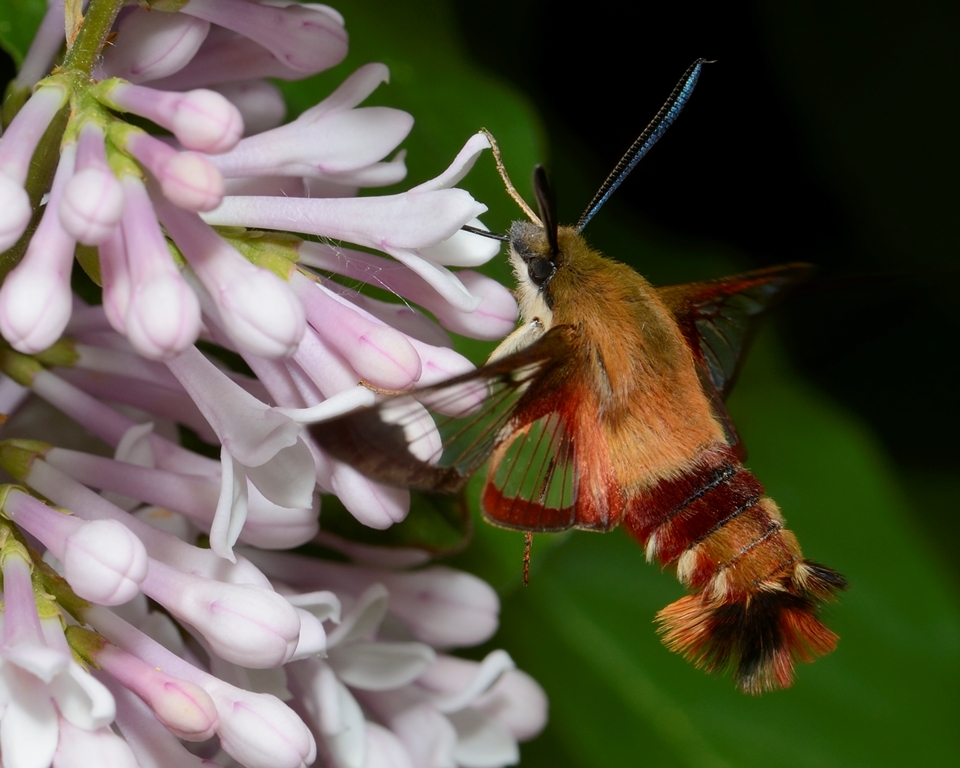
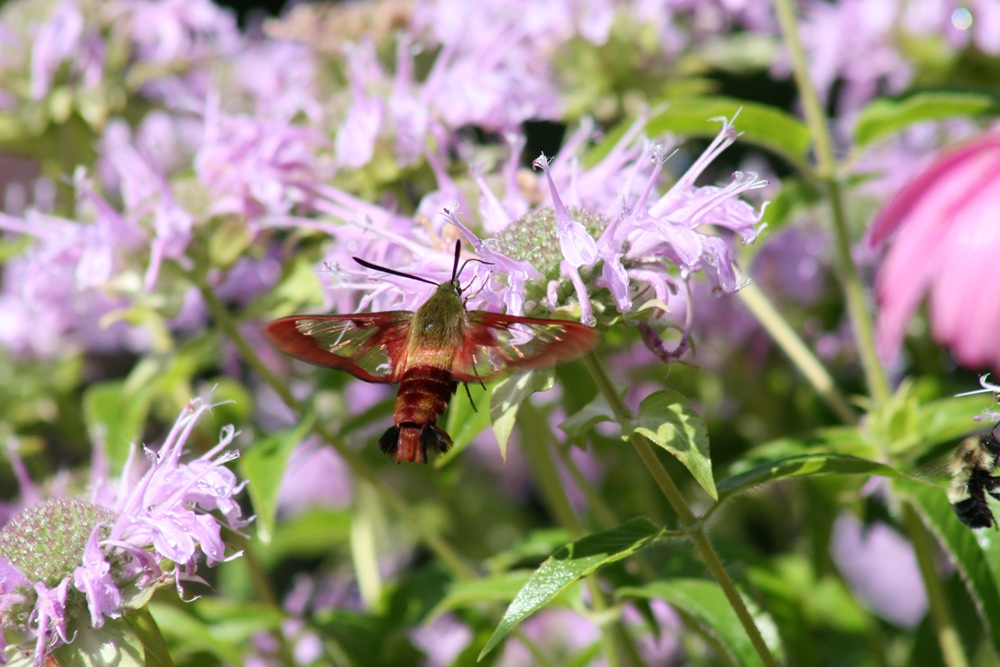
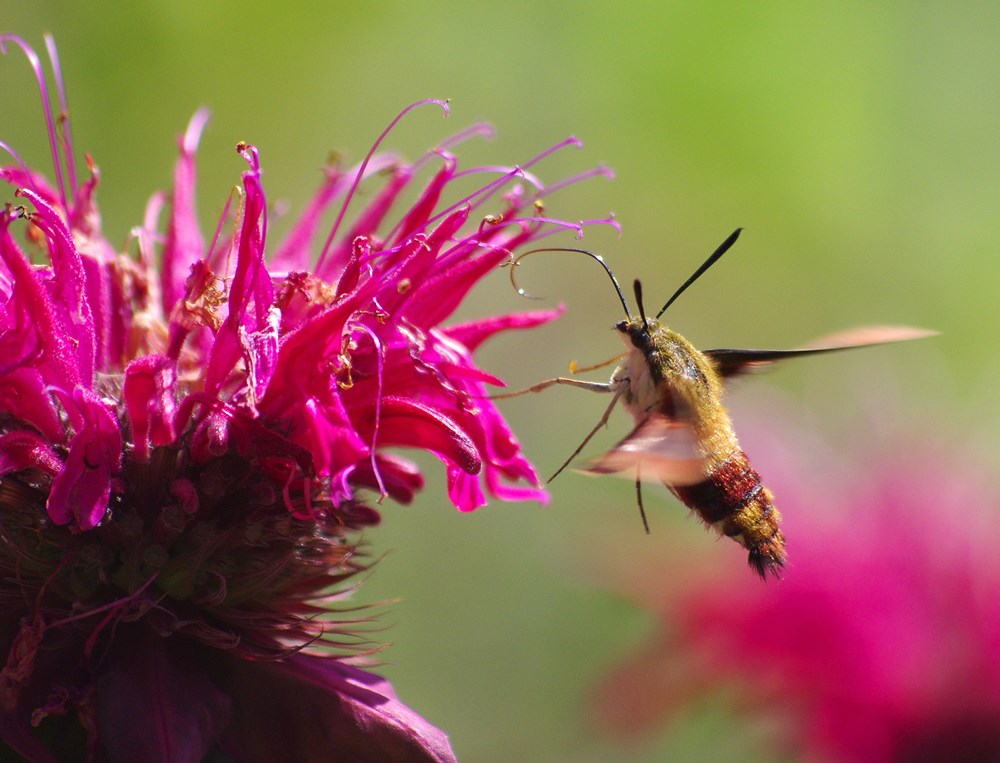
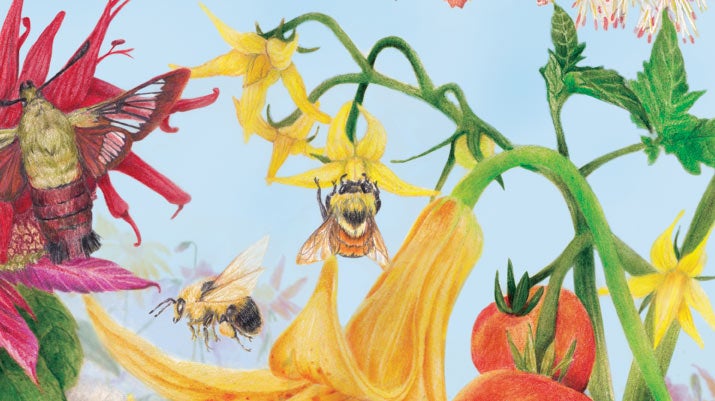
Les adultes (c’est-à-dire les papillons) ont une envergure de 4 à 5,5 cm environ. Leur tête et la partie thoracique de leur dos sont de couleur olive à beige, tandis que le dessous de leur thorax est crème ou blanc. Le bas de leur dos et leur ventre (abdomen) sont marron foncé ou noirs (mais la partie inférieure du bas du dos peut être plus pâle). Les ailes sont transparentes avec un pourtour et des nervures marron.
Les chenilles sont de couleur vert clair avec une ligne de points blancs au bout de laquelle se trouve un appendice charnu pointu ressemblant à une queue. Les côtés présentent de petites taches rougeâtres.
ESPÈCES SEMBLABLES :
Le sphinx gracieux (H. gracilis) et le sphinx du chèvrefeuille (H. diffinis) ont des motifs différents sur la partie supérieure des ailes antérieures (cellule discoïdale); H. thysbe présente à cet endroit deux petites nervures horizontales – la distinction est cependant difficile à faire lorsque les papillons volent. Les sphinx gracieux et les sphinx du chèvrefeuille ont des couleurs différentes sur le corps, et leurs pattes sont plus foncées; les sphinx gracieux ont une bande pâle au milieu du dos et leurs pattes sont rouges; chez les sphinx du chèvrefeuille, la partie supérieure du dos est plus pâle et les pattes sont noires.
GALERIE DE PHOTOS :
 | |  |
RÉPARTITION :
Un peu partout au Canada, sauf au Nunavut.
HABITAT :
Forêts claires et terrains à végétation arbustive, jardins, prés.
RÉGIME ALIMENTAIRE :
Les adultes (c’est-à-dire les papillons) boivent le nectar de fleurs d’espèces variées, notamment des monardes, le trèfle violet, des lilas, des phlox, des symphorines, des canneberges, des bleuetiers et des vesces.
Les chenilles mangent les feuilles de chèvrefeuilles (Lonicera spp.), de symphorines (Symphoricarpos spp.), d’aubépines (Crataegus spp.), de cerisiers et de pruniers (Prunus spp.).
COMPORTEMENT :
Les sphinx colibris volent et se nourrissent de jour. Les adultes se nourrissent de nectar en volant en surplace devant les fleurs, à la manière des colibris, et non comme les abeilles, qui elles se posent sur les fleurs. À la fin du stade larvaire, les chenilles s’enfouissent dans la litière pour y faire leur cocon, dont elles sortent sous forme de papillons peu de temps après ou au printemps suivant.
RÔLES ÉCOSYSTÉMIQUES PRINCIPAUX :
- Pollinisation (les sphinx colibris boivent le nectar de fleurs ouvertes ou profondes; comme du pollen adhère à la partie supérieure de leur corps, ils pollinisent un grand nombre de ces fleurs).
SITUATION :
(information vérifiée le 10 février 2014)
- COSEPAC : non évaluée
- NatureServe : N5 (non en péril sur le plan national), G5 (non en péril sur le plan mondial)
N. B. : Ces organismes s’efforcent de présenter une information à jour, mais l'évaluation ou la réévaluation de la situation d’une espèce prend du temps et il peut donc y avoir un délai avant que l'information présentée traduise les changements survenus dans cette situation.
Périls auxquels l’espèce est exposée et ce que vous pouvez faire pour l’aider :
Bien qu’aucun péril n’ait été officiellement identifié pour cette espèce, vous pouvez rendre service à ses représentants en cultivant des plantes de diverses espèces indigènes à votre région qui donneront de la nourriture aux adultes comme aux chenilles.
Notes :
Merci beaucoup à Chris Darling, Antonia Guidotti et Peter Hall pour leur aide relative au profil de cette espèce.
PLUS D'INFORMATION SUR CETTE ESPÈCE :
RÉFÉRENCES :
Peterson Field Guides – Eastern moths. Covell, Charles V. Jr., 1984. Houghton Mifflin.
http://www.butterfliesandmoths.org (en anglais)
http://pnwmoths.biol.wwu.edu (en anglais)
http://bugguide.net (en anglais)
http://eol.org/pages/508212/overview (en anglais)
Text by Terri-Lee Reid
Images by Tom Lusk
Resembling both a bumblebee and a hummingbird, the hummingbird clearwing moth is a treat to discover.
Hovering in front of a flower, beating its wings so fast they blur and retrieving nectar with its long proboscis, there’s no wonder this beautiful creature makes us take a moment for a second glance.
A member of the sphinx moth family, the hummingbird clearwing moth has a wingspan of between four and six centimetres. Initially their wings are covered with reddish-brown scales, but after their first flight, these scales fall off leaving behind “clearwings” with the exception of veins and wing borders. Their bodies taper at both ends and are covered in olive green hairs with reddish-brown bands across the abdomen.
Unlike most other moths, clearwing hummingbird moths are active during the day. They can be seen fluttering around fields, forest edges, meadows and cultivated gardens extracting nectar from flower blossoms. The far-ranging species can be found from Newfoundland west to British Columbia, and even in Canada’s North.
The clearwing hummingbird caterpillar is yellowish-green all over with red-brown spots on its abdomen, dark green lines on its back and a horn on its tail. Rarely considered a pest, these caterpillars feed on the leaves of honeysuckle, viburnum, hawthorn, snowberry, cherries and plums.
As caterpillars, they wrap themselves in cocoons made of leaf litter and spend the winter on the ground. They emerge as beautiful clearwing hummingbird moths that can be seen flying from May typically through until July.
While adults share some of the same plant choices as the larvae, clearwing hummingbird moths also get their nectar from beebalm, phlox, cranberry, vetch and red clover.
The best way to attract this daytime-flying moth to your backyard is to grow a range of plants that attract both the caterpillar and the moth. It’s important to provide for all life stages. Avoid the use of chemical pesticides, which often harm organisms other than those intended. Caterpillars will also benefit from leaf litter left on the ground, which they will use to construct cocoons to overwinter in.
This spring, remember to take a closer look. You may just be lucky enough to find a clearwing hummingbird moth in your own backyard!

Apprenez-en davantage
- 0
- 1


