In 1991, the Wildlife Ministers’ Council of Canada adopted a new policy developed by CWF that included an expanded definition of the diversity of wildlife. Newly added to the definition: algae, bacteria, fungi, plants, invertebrates, reptiles, amphibians and fish.
Under the new definition, reptiles like freshwater turtles were recognized as wildlife and entitled to the same level of protection as mammals and birds.
All eight species of freshwater turtles in Canada are currently at-risk. CWF and our partners are working to reduce risks to turtles with our Saving Turtles At-Risk Today (START) program. Our goal is to ensure the long-term survival of turtle populations by focusing on three key priorities: protecting wetland habitat, decreasing road mortality and increasing hatchling survival.
Rivers to Oceans
CWF joined the National Wildlife Federation in 1998 to endorse the International Year of the Ocean. Communities, schools and individuals engaged with CWF to discover what they could do to conserve Canadian sea life and marine habitat. Today, CWF celebrates Rivers to Oceans Week (June 8-14) by encouraging Canadians to learn about how we are all connected to our waterways.

There are plenty of ways we can all #DoMoreForWildlife
- Celebrate with us during Rivers to Oceans week! June 8 -14. Sign up here to learn when the activities begin >
- Why did the turtle cross the road? Hint; not to get to the Shell station. Help turtles SAFELY cross the road! Watch this video that shows you how!
- SLOWWW Down. Be a turtle observer. Contribute your time to CWF’s iNauturalist turtle project >
- Have turtles on our property? Help keep them safe by building a nest protector. Here’s how >
- Give a plush painted turtle a home! Purchase a CWF Adopt- an-Animal Painted Turtle. Each adoption kit comes with an adoption certificate, species information brochure, plush toy and a $20 tax receipt. Proceeds help support conservation education and research. Adopt now >
- Register for our turtle webinar, May 18, 2022. Learn how >
- Request your Help the Turtles poster! Request today >
You can also enter our 60 Days of Conservation Contest for a chance to win one of six exciting CWF #DoMoreForWildlife prize bundles or our grand prize.
Signature Species:
Freshwater Turtles

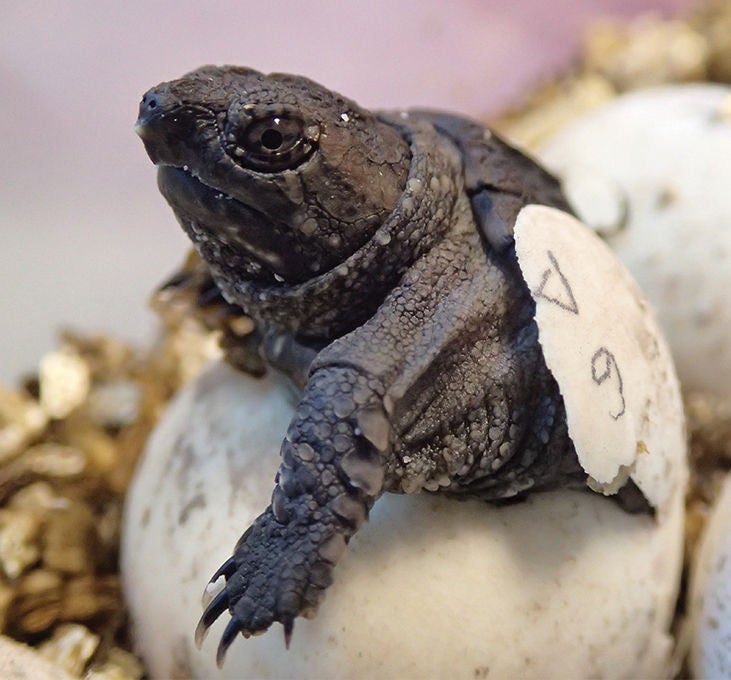
Freshwater turtles are reptiles, like snakes, crocodilians and lizards. Like other reptiles, they are ectothermic, or “cold-blooded”, meaning that their internal temperature matches that of their surroundings. They also have a scaly skin, enabling them, as opposed to most amphibians, to live outside of water. Also like many reptile species, turtles lay eggs (they are oviparous).
But what makes them different to other reptiles is that turtles have a shell. This shell, composed of a carapace in the back and a plastron on the belly, is made of bony plates. These bones are covered by horny scutes made of keratin (like human fingernails) or leathery skin, depending on the species. All Canadian freshwater turtles can retreat in their shells and hide their entire body except the Common Snapping Turtle (Chelydra serpentina). This shell is considered perhaps the most efficient form of armour in the animal kingdom, as adult turtles are very likely to survive from one year to the next. Indeed, turtles have an impressively long life for such small animals. For example, the Blanding’s Turtle (Emydoidea blandingi) can live for more than 70 years! Most other species can live for more than 20 years.
Turtles have been on Earth for more than 200 million years, surviving major events like the extinction of dinosaurs, numerous ice ages and more. Today, our freshwater turtles face a new challenge: human activity. The fact that freshwater turtles need both terrestrial and aquatic habitats to survive makes their conservation relatively complex, since many types of habitats need to be protected for a single species. The need for several types of habitats throughout the year also increases the amount of threats affecting them, since different elements can threaten them in each habitat. Unfortunately, freshwater turtles are indeed having a hard time. All eight species of freshwater turtles in Canada are at risks.
Excerpts compliments of Hinterland Who’s Who
Freshwater Turtles in Four Indigenous Languages
You can also watch the video in one of these Indigenous languages – Denesuline, Oji-Cree, Woods Cree, Ojibway, Mohawk and Inuktitut.