In 2003, the Canadian Wildlife Federation joins with Environment Canada to bring back the cultural institution Hinterland Who’s Who with the first of many new public service announcements. One of the longest running public education programs in Canada, Hinterland Who’s Who was originally launched in 1963 and brought wildlife into the homes of Canadians through what was then the new technology of television. Today, the program is still going strong, attracting new audiences and followers. Here’s the latest video about the wolf!
Thousands of supporters joined with CWF in 2009 to sign our petition regarding proposed amendments to the formerly named Navigable Waters Protection Act. NWPA considered impacts on navigation and the environment. Those who wanted to build in, on or over Canadian waterways triggered an environmental assessment approval process in the Act. Under the amendments, a “class of works” and a “class of navigable waters” would be designated that would make certain projects exempt from the NWPA approval process, and consequently from a federal environmental assessment. While the 2009 amendments were passed, after continued advocacy by CWF and others, many of the issues were resolved in 2019 when the government made substantial amendments to the now named Canadian Navigable Waters Act to restore lost protections.
Breaking Barriers to Fish Passage
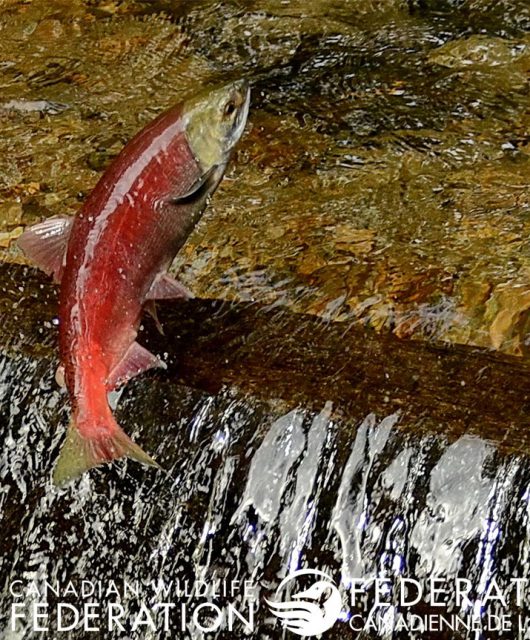
Thanks to funding from the BC Salmon Restoration and Innovation Fund and the Canada Nature Fund for Aquatic Species at Risk, CWF is currently working with partners to remove barrier to fish passage in British Columbia. Many of these barriers, including a number of culverts, floodgates, levees and dykes, were installed prior to provincial legislation introduced to regulate their construction and management. As a result, these barriers are now unclaimed and considered orphans. In order to clear the way for fish needing to move freely, the B.C. Fish Passage Restoration Initiative is working to restore access to critical spawning and rearing habitat for Chinook, Coho and Sockeye Salmon; Bull Trout; Steelhead; and Westslope Cutthroat Trout species.

There are plenty of ways we can all #DoMoreForWildlife
- Know Your Salmon! Commit to avoiding farmed salmon – unless it comes from a closed containment system. Find out more here!
- Break Down Barriers! Watch these short videos to learn how CWF is helping bring our salmon home >
- Love Your Lake! Keep your lake healthy by naturalizing your shoreline. Find out more at LoveYourLake.ca >
- Check out our Hinterland Who’s Who vignette about Pacific Salmon >
- Introduce a new generation to the magical world of Hinterland Who’s Who with “The Wild Gang” app. It’s filled with interactive games, fun activities and quizzes and videos sure to excite the young wildlife enthusiast in your life. Learn more >
You can also enter our 60 Days of Conservation Contest for a chance to win one of six exciting CWF #DoMoreForWildlife prize bundles or our grand prize.
Signature Species:
Coho Salmon
Adult Coho Salmon have silvery sides and metallic blue backs with irregular black spots. Spawning males have bright red sides, and bright green backs and heads, with darker colouration on their bellies. The fish have hooked jaws and sharp teeth. Young Coho Salmon are aggressive, territorial and often vibrantly coloured, with a large orange anal fin edged in black and white.
As a population, Interior Fraser River Coho Salmon are descended from now-extinct populations of coho that survived the ice age by migrating to the upper Columbia River. The Interior Fraser River population is genetically distinct from Coho Salmon that live in the lower Fraser River watershed.
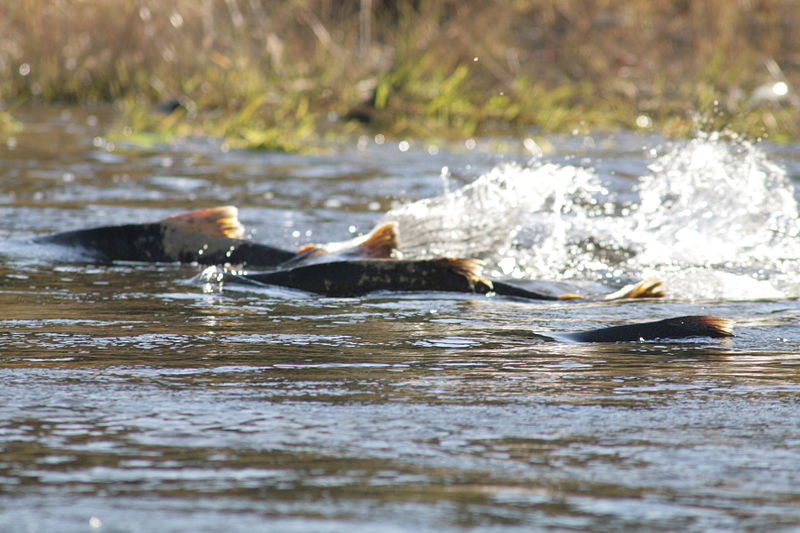
Coho Salmon return to the Interior Fraser River watershed during fall to spawn. The female turns onto her side and flaps her tail up and down to create a depression—called a redd—in the gravel of the river bed. When the redd is deep enough, the female will lay her eggs. All the while, the female is defended by a dominant male. While the eggs are laid, the dominant male releases sperm into the gravel nest. At times, other males may also deposit sperm. The female then covers up the fertilized eggs with gravel to protect them from predators and begins to create another redd. Typically, a female will spawn in three to five redds, and lay between 800 and 1,000 eggs at each one. After spawning, the Coho Salmon defend their redds until they die some three to 15 days later.
Having rapidly declined since 1996, the Interior Fraser River coho salmon populations are still under threat from shifting marine conditions and deteriorating freshwater habitats. This population is also caught by other fisheries in coastal waters off Oregon, Washington and Vancouver Island, as well as in the Strait of Georgia and in the Fraser River.
Excerpts compliments of Hinterland Who’s Who
Indigenous Teachings
The Canadian Wildlife Federation partnered with Carcross/Tagish First Nation, Carleton University and the Yukon Energy Corporation, among others, to identify spawning sites used by Chinook Salmon in the Upper Yukon River. Elder Betsy Jackson shares her story.