

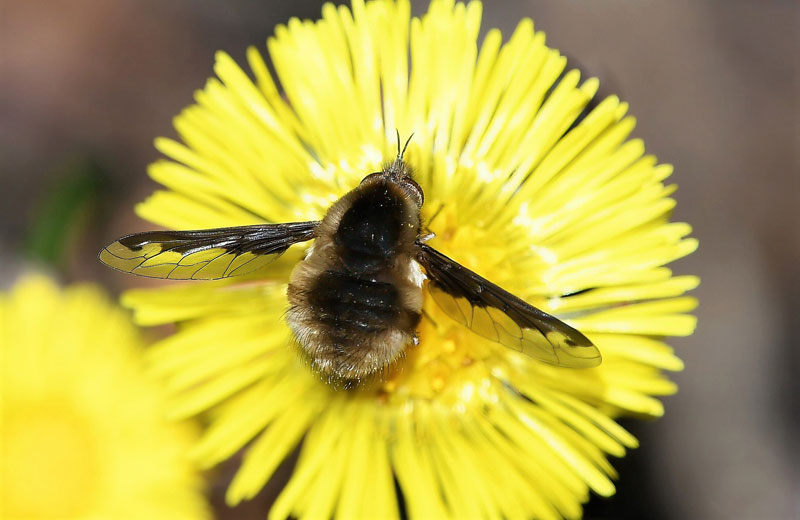


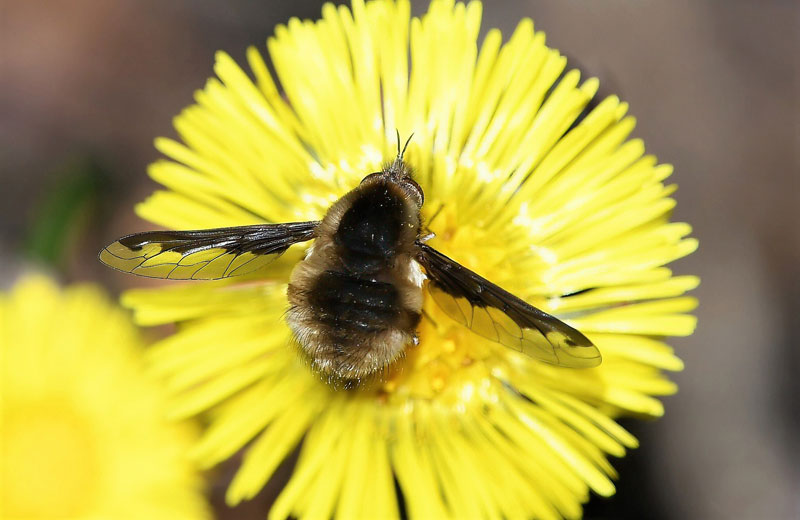
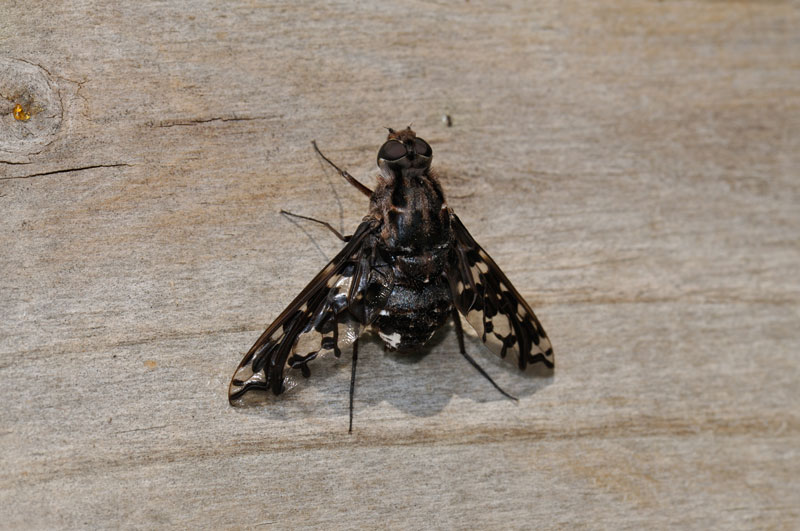
Bee flies are mostly stocky flies with long, beak-like mouthparts that spend a lot of time hovering. Unlike flower flies which mostly settle on flowers to feed, most bee flies continue to hover while feeding (although there are exceptions in both families).
Many species of bee flies are pollinators and conspicuous members of our community. In particular, watch for the Greater Bee Fly (Bombylius major) in the early spring as soon as the first flowers appear. These flies, and others out at the time, pollinate our early native flowers like Spring Beauty, hepatica and willows and also often rely on introduced dandelions or coltsfoot. Greater Bee Flies are active when some of the early spring bees that look similar are active. Like flower flies, many bee flies are mimics of bees and wasps. Larvae of bee flies are predators or parasitoids of eggs and larvae of wasps, bees, beetles and other insects. Watch for them in sandy areas where there are bee and wasp nests and you may see the female bee flies lobbing eggs into the bee or wasp burrows. There are only 130 bee fly species in Canada. The group is much more diverse in desert areas where they are superbly adapted by having amongst the best water conservation system in insects. A counter-current exchange system squeezes almost every drop of moisture out so that they are not losing water while breathing. Over 4,500 species have been identified worldwide.