

SCIENTIFIC NAME
Colaptes auratus
CLASSIFICATION
Kingdom: Animalia
Phylum: Chordata
Class: Aves
Order: Piciformes
Family: Picidae
DESCRIPTION
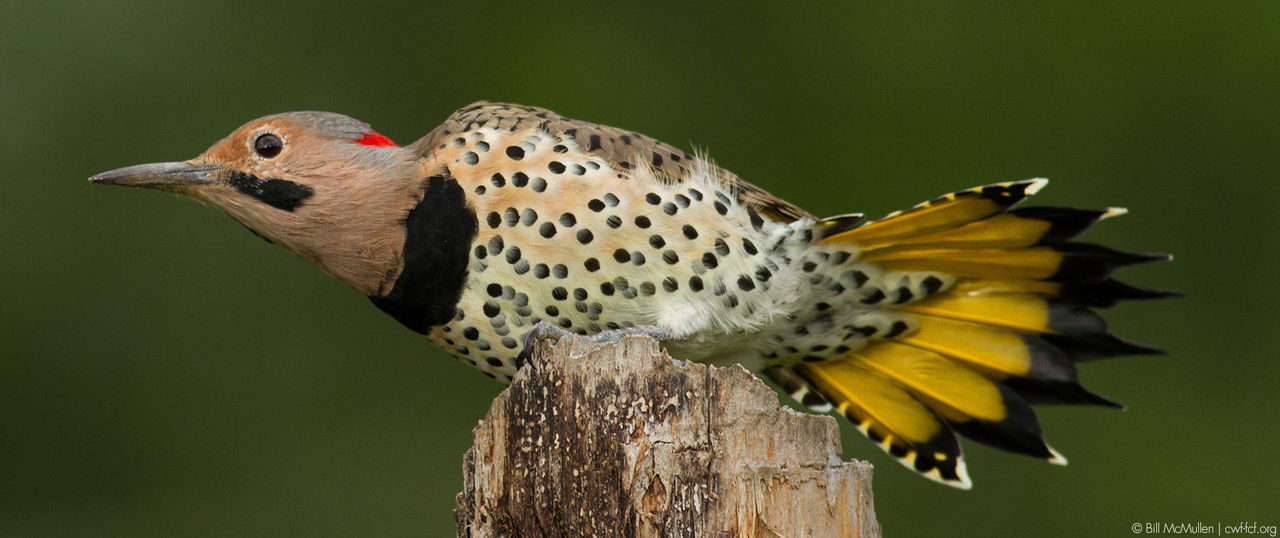
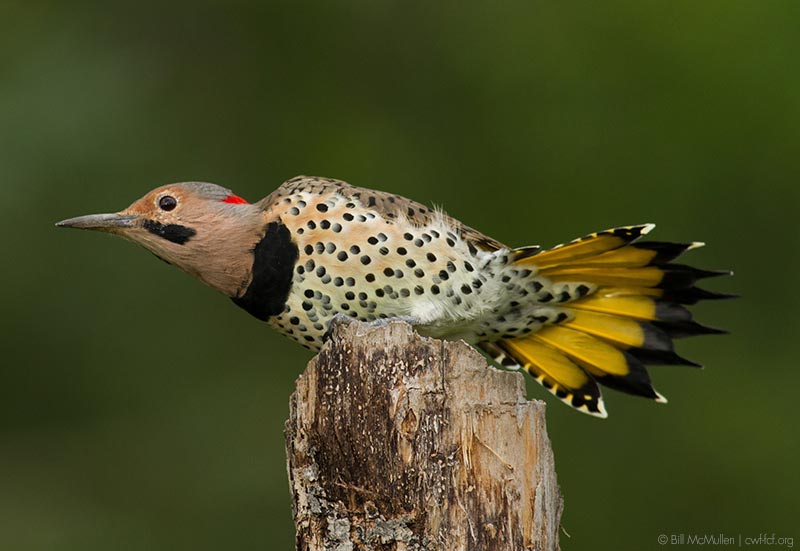
Northern Flickers are a mid-sized woodpecker reaching approximately 32 centimetres. There are two types, the more widely spread Yellow-shafted Northern Flicker and the Red-shafted found mainly in southern British Columbia. Both have a spotted breast, black breast band below the throat, black barring on their backs (lines that run across their backs from wing to wing) and white patch on their rump, visible in flight. The Yellow-shafted males have a red patch at the back of their heads, a black stripe down the side of their brown face and brilliant yellow under their wings and tail. Red-shafted males, however, lack the red patch on the back of their heads, have a red stripe down the side of their grey face and a bright orange-red colour under their wings. They also have a bit of white around the black breast patch. Females of both sub species appear the same except for the lack of the red or black stripe down the side of their face. In areas where both sub species are found close they sometime hybridize making identification tricky.
SIMILAR SPECIES
There are no similar species native to Canada
PHOTO GALLERY
(Please note — these photos are unverified images submitted by members of the CWF Photo Club.)
RANGE
Northern Flickers are found all across Canada in the summer months. Yearround they can be found in the southern portion of all provinces (and across small Nova Scotia, P.E.I. and New Brunswick) and along the British Columbia coastal region.
HABITAT
Look for Northern Flickers in both rural and suburban areas that have mature trees (for nesting and roosting) and open ground or low growing plants nearby (for eating ants).
DIET
Northern Flickers spend their time on the ground searching for and eating ants. They hunt for ants along the side of quiet country roads, in wooded clearings, in gardens and away from the cover of trees. They will also eat beetle larvae and at times other invertebrates. As this food source dwindles with the cooler weather, they turn to berries and the seeds of plants like poison ivy, sumacs, bayberry, raspberry, poison oak, thistle, purslane and pigweeds in the Amaranthus genus.
BEHAVIOUR
Like other woodpeckers, Northern Flickers drum to communicate amongst themselves. They are also one of the more migratory woodpecker species, reaching in the far north in the summer and travelling to the southern portion of the country in the winter months. Southern populations often stay in the same area.
PRIMARY ECOSYSTEM ROLES
Northern Flickers are primary cavity nesters – meaning they make their own holes – and are therefore extremely important to the secondary cavity nesters who use existing holes for their own nests and roosting spots.
They also serve to keep ant populations in check, and to some degree, beetles as well.
Northern Flickers are primary cavity nesters – meaning they make their own holes – and are therefore extremely important to the secondary cavity nesters who use existing holes for their own nests and roosting spots.
They also serve to keep ant populations in check, and to some degree, beetles as well.
THREATS AND/OR WHAT YOU CAN DO
The Birds of North America Online cites a significant decline noted by the Breeding Bird Survey data. Suspected reasons include habitat loss as dead or dying trees are cut down, competing with the European Starlings for cavities to use as nesting site and the use of pesticides in feeding areas such as farms, golf courses and residential areas. To ensure Northern Flickers and other cavity nesting birds have sufficient habitat and a safe food supply, consider leaving dead or dying trees standing, where it is safe to do so. If necessary, trim potentially dangerous branches and allow the trunk to stand a few years more. This will provide a source of food and shelter for these and other birds that require cavities for roosting (sleeping) and nesting. It will also provide a source of food with spiders and insects living along the trunk and branches.

Learn More
- 0


