


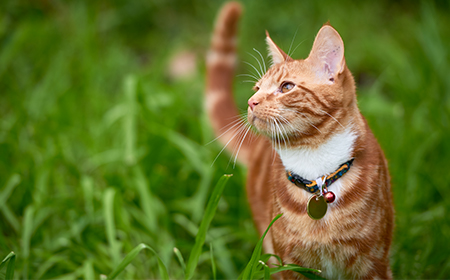
Q. I just adopted an outdoor cat. I want to make sure it doesn't hurt the wildlife outside. How do I convince my cat to become an indoor cat?
There are many reasons to keep cats as indoor pets. First, it is estimated that cats kill between 100 and 350 million birds each year in Canada. Plus, it’s safer for cats to live their lives inside as outdoor cats face many threats including cars, predators and disease.
While some cats will transition to living exclusively inside quite easily, others may need a bit more time to be convinced of the comforts of indoor living.
A gradual process
It is generally best to slowly begin getting your feline friend used to being inside by feeding them indoors and gradually keeping them inside for longer periods of time once mealtime is over. This lets them get used to your home and gives them a chance to leave their scent on furnishings while exploring. With fall approaching and the arrival of colder weather, this could actually help! Your cat may just welcome a warm, dry abode. However, there are some cats that don’t do well with the gradual approach. For these situations, it’s recommended to bring them inside and keep them in.
You’ll need a litter box
If your cat lived exclusively outside, they may not know what a litter box is! Keep it simple. It should be large in size, although not high, and it might help if the litter resembles a substrate that the cat would find outside – perhaps garden soil or sand. It should be open, so no dome-shaped covering and don’t hide it in a closet either. Keep it out in the open so it’s easy to find. You may have to show them where the litter box is by simply scratching the litter a few times. Once your cat is used to the litter box, then you can transition to a clumping litter or a closed box. Some people find it helpful to set the litter box on a small mat or piece of carpet to help catch the litter that might get stuck to their paws.
You’ll want some scratching posts
Outdoor cats are used to scratching anywhere they please, but you won’t want your furniture to become their scratching outlet. Instead, provide a few scratching posts for them to perform this natural behaviour.
Don’t forget about the toys!
Cats have a natural instinct to hunt, so provide them with toys they can chase and pounce on. They don’t have to be elaborate. Many cats prefer a ball of aluminum foil, crumpled paper, cardboard boxes, paper bags or a thick shoelace tied in loops or knots at the end. Of course, toys in the shape of mice, those with feathers and laser pointers are also good at keeping cats busy. To keep your cat from getting bored, rotate toys every couple of weeks. If you’re worried that some toys might be a hazard for your cat, keep those for supervised play!
Give your cat a cat tree/perch
Cats like to check out their environment from above, that’s why they like to climb trees. They also feel safe up high, away from predators. Even though your indoor cat doesn’t have to worry about predators, chances are they’ll feel safe atop a cat tree or perch. You’ll want to make sure it’s sturdy and offers platforms for resting. Your cat may find it even more enticing if it’s placed near a window where it can watch some backyard birds. If your windows are open, make sure your screens are secure
Offer a little bit of cat grass
Another natural behaviour of cats is to nibble on grass. While it seems the exact reason cats like to eat grass is yet to be discovered, there are several thoughts on the matter – it may help cats get rid of undigestible parts of their prey, it may be a form of fiber that helps cats throw up or digest hairballs and/or it may provide them with some trace minerals and vitamins. Whatever the reason, many cats love to eat grass and by offering cat grass it may also help keep them away from your house plants!
Make breakaways a little less enticing
If your cat tries to make a run for the door every time it opens, try making outside a little less inviting. Suggestions include shaking a jar of pennies, giving a little squirt of water from a water gun, or creating a diversion by tossing a treat to the other side of the room.
A couple of ways to safely let your cat outside
Some cats can be trained to walk on a harness and leash so you can take them for a walk. Or you can build a catio – a screened-in enclosure that allows your cat to be safely outside.
Contact your vet
Your vet may be able to answer any questions that arise when transitioning your outdoor cat to an indoor cat. Don’t hesitate to ask others what worked for them!


