


SCIENTIFIC NAME
Stylophorum diphyllum
OTHER COMMON NAMES
Celandine poppy, yellow poppy
DESCRIPTION
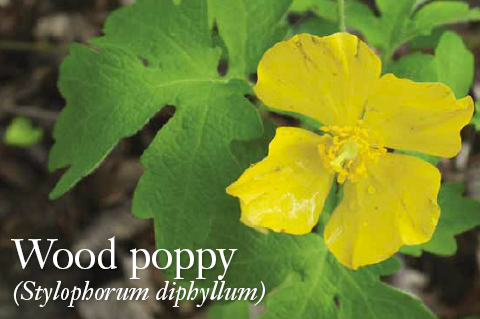
The wood poppy stands up to 40 centimetres tall. The leaves are mainly basal and up to 15 cm long and 6 cm across with a paler underneath with five to seven deeply divided, irregular lobed or toothed segments. The flower is deep yellow with four petals each 2 to 5 cm long; occur in clusters of up to four, blooming in May and early June. The fruit is a greyish hairy seed pod capsule divided into three or four longitudinal segments. All parts have a bitter yellow sap.
SIMILAR SPECIES
Pale poppy (Papaver alboroseum), Arctic poppy (P. radicatum)
RANGE
In Canada, restricted to three small, fragmented sites near London in southwestern Ontario.
HABITAT
Carolinian forest
BEHAVIOUR
The wood poppy is propogated by ants.
PRIMARY ECOSYSTEM ROLES
The wood poppy feeds bees and other pollinators, mice (seeds), whitetailed deer and other browsing mammals.
THREATS AND/OR WHAT YOU CAN DO
Threats to the Wood Poppy include invasive plants and trampling during recreational activities. If you see it consider yourself privileged to catch a glimpse of this imperilled species.
NOTES
This plant is listed as endangered by COSEWIC in 2000; plant and habitat protected under Ontario’s Endangered Species Act. Relatives of the wood poppy include the pale poppy (Papaver alboroseum), and the Arctic poppy (P. radicatum).


