


SCIENTIFIC NAME
T. cordifolia and T. trifoliata
DESCRIPTION
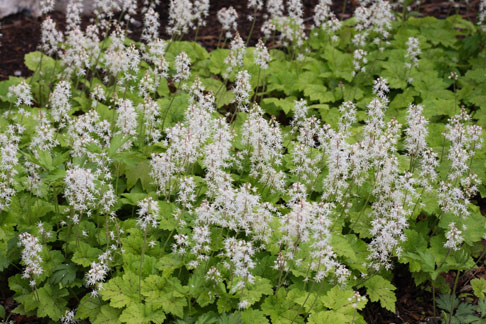
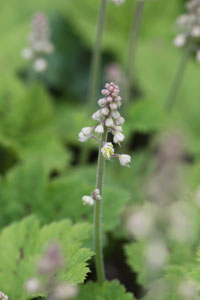
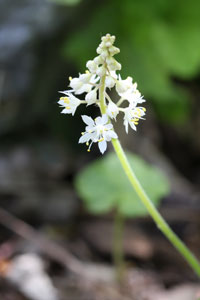
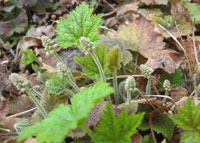
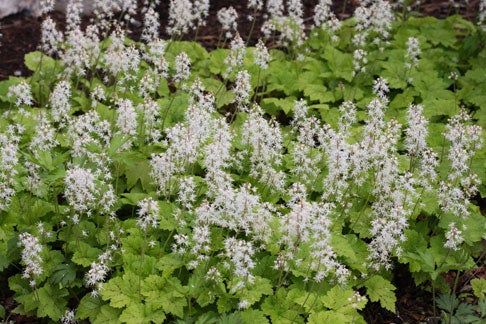
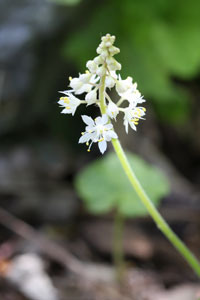
While there is variety within the two species, both species and their respective forms, share some basic characteristics. Foamflowers have white blooms that grow on a spike that rises above large heart-shaped or maple-like leaves that can form an attractive ground cover.
PHOTO GALLERY
|  |  |
 |
RANGE
There are two species of Tiarella, also known as foamflower, in Canada. T. cordifolia grows in the eastern provinces of Ontario, Quebec, Nova Scotia and New Brunswick and T. trifoliata graces British Columbia and southwestern Alberta.
HABITAT
Tiarellas grow best in moist rich soil, mimicking the moist woods they would naturally inhabit. Partial shade is best, although they can handle deep shade, as well.
BEHAVIOUR
Collect seeds when the seed capsule looks brown and dry. Sprinkle the little black seeds on soil without covering with additional soil. If you store them for a long time, keep them cool and moist for about three months before planting.
PRIMARY ECOSYSTEM ROLES
Foamflowers are a source of food for Canadian wildlife. Their seeds and leaves help birds, such as the ruffed grouse, while flowers offer pollen and nectar to local pollinators.
By Sarah Coulber
 | |
Canadian woodlands boast a variety of wildflowers that light up the ground with their pretty blooms. Some are like little gems that are best appreciated close up while others, such as trilliums, form a brilliant carpet across the forest floor that can take your breath away from a distance. Tiarellas are pretty woodland plants that have inspired gardeners to grow them at home, for their blooms and for their ability to provide good ground cover.
 | |
Appearance
While there is variety within the two species, both species and their respective forms, share some basic characteristics. Foamflowers have white blooms that grow on a spike that rises above large heart-shaped or maple-like leaves that can form an attractive ground cover.
T. cordifolia (also called T. cordifolia var. cordifolia) grows to 40 cm and spreads easily without being invasive. It blooms in the spring.
The western T. trifoliata (T. trifoliata var. trifoliata) is slightly larger and has flowers that are more delicate and bloom in the summertime. It has Canadian varieties such as var. unifoliata, whose leaves are not as deeply lobed and which has finer, less showy flowers, and var. laciniata, which has deeply cut leaves and grows primarily along the BC coast.
 | |
Propagation
Collect seeds when the seed capsule looks brown and dry. Sprinkle the little black seeds on soil without covering with additional soil. If you store them for a long time, keep them cool and moist for about three months before planting.
Foamflowers with long creeping stems (stolons) can be rooted in the summer, just as you would a cutting. Make sure you leave at least one leaf per cutting. Otherwise leaves can be rooted by dunking the leaf base in a rooting mix.


