


SCIENTIFIC NAME
Asteraceae or Compositae family
DESCRIPTION
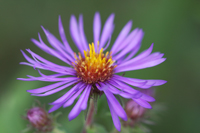
Blooming anywhere from late summer to late fall, aster flowers range from 1 to 5 cm wide with many long thin petals. They have composite flower heads. This means that each flower is actually a group of smaller flowers consisting of ray flowers (petals) surrounding disk flowers (the centre). Disk flowers are usually yellow or burgundy, which make a nice contrast with the blue, purple, violet, or white ray flowers. An added attraction is their sometimes striking purple stems.
SIMILAR SPECIES
PHOTO GALLERY
(Please note — these photos are unverified images submitted by members of the CWF Photo Club.)
RANGE
A diverse group of hardy plants, asters grace most regions and habitats across Canada.
HABITAT
Commonly seen in fields and on roadsides, some species prefer wetlands, woodlands, or even alpine areas.
BEHAVIOUR
Seeds are dispersed in autumn breezes and, depending on the species, may germinate that season or the following spring. New plants may grow quickly enough to flower and develop seeds in their first year.
PRIMARY ECOSYSTEM ROLES
As a food source, asters are invaluable to birds, mammals, and insects alike. Nectar and pollen from these plants are an important fall food source for butterflies, moths, bees, and other beneficial insects, when most other flowers have already finished flowering. If the asters are left to go to seed, birds will also grace your garden in the fall and winter to enjoy the feast.
When summer flowers fade and the days grow shorter, asters take the stage, brightening the landscape with their array of blues, purples, and whites. A diverse group of hardy plants, asters grace most regions and habitats across Canada. Commonly seen in fields and on roadsides, some species prefer wetlands, woodlands, or even alpine areas. Pleasing to the eye and beneficial to wildlife, asters are a great addition to any garden.
Appearance
Blooming anywhere from late summer to late fall, aster flowers range from 1 to 5 cm wide with many long thin petals. As members of the Asteraceae or Compositae family (sometimes called the daisy, sunflower, composite, aster, or even thistle family) they have composite flower heads. This means that each flower is actually a group of smaller flowers consisting of ray flowers (petals) surrounding disk flowers (the centre). Disk flowers are usually yellow or burgundy, which make a nice contrast with the blue, purple, violet, or white ray flowers. An added attraction is their sometimes striking purple stems.
While asters are generally a branching plant, they come in a variety of shapes and heights. This allows them to fill many different roles in the garden, from compact border plant to tall backdrop or even dainty centre of attention.
Uses
As a food source, asters are invaluable to birds, mammals, and insects alike. Nectar and pollen from these plants are an important fall food source for butterflies, moths, bees, and other beneficial insects, when most other flowers have already finished flowering. If the asters are left to go to seed, birds will also grace your garden in the fall and winter to enjoy the feast.
Humans have also made use of asters through the centuries. According to the authors of Up North Again, Ojibway hunters camouflaged their scent by smoking aster rootlets to simulate the scent given off by deer. Native American Indians have also used different parts of the plant for its healing abilities, and at least one species (the large-leaved aster) is known to have edible parts.
(Caution: We are not recommending the use of these plants for medicinal or food purposes. Many plants are poisonous or harmful if eaten or used externally. The information on food and medicinal value is only added for interest. This information has been gathered from books and its accuracy has not been tested.)
Care
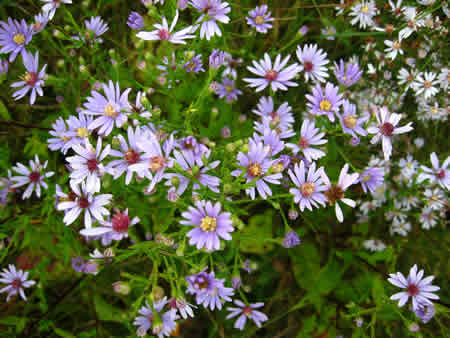
Caring for asters is pretty straightforward provided the plant is in its preferred environment. Dwarf varieties should be spaced at least 30 cm apart, the tall varieties up to a metre apart. Taller asters may require support, depending on the environment and the species. In that case, either surround the aster with plants that have tall strong stems or stake it using a stick and string. You can camouflage the stake by surrounding the aster with mid-sized plants. Another method to reduce flopping is by cutting back (just above a leaf if possible) in the early summer (in June or when shoots are about 30 cm tall). You'll end up with more flowers, albeit later in the season, than if you had not trimmed the plant.
As with most perennials, dividing a clump of asters keeps it looking tidy and healthy. Divide every two to three years, or when the centre looks like it is dying out. Divide plants in early spring or in late fall once they have finished blooming. Remove the centre and replant the vigorous young divisions from the outside of the clump.
The only real concern with asters, as with many other plants, is powdery mildew. Help your asters keep it at bay by having plenty of space between plants to allow for good air circulation, watering in the morning at soil level (to prevent the leaves from getting wet), and using soil amended with compost. Compost and many other slow-release organic fertilizers nourish the plant as well as the soil organisms that keep the plant healthy — unlike chemical fertilizers, which often repel or kill these unseen allies.
Propagation
Seeds are dispersed in autumn breezes and, depending on the species, may germinate that season or the following spring. New plants may grow quickly enough to flower and develop seeds in their first year. If you want to propagate your asters, do so from either seeds or cuttings. William Cullina of the New England Wild Flower Society, in his book Growing and Propagating Wildflowers of the United States and Canada, suggests propagating with stem cuttings in late spring. Pot the cuttings soon after rooting to allow their crowns to mature. If collecting seed, plant the seeds that autumn or store them in the refrigerator and plant once the spring air has warmed the ground. Seeds are much more likely to germinate if they come from plants that have been growing near others of the same species, rather than from a single specimen.
The seeds are beneficial to wildlife. However, if you have more than one plant and don't want them to self-seed, cut back several of the finished flowers in the fall. Choose your species carefully as some asters spread by rhizomes, which is great to fill a large area or meadow but may not be suitable in a small garden.
Here are some species that you might consider growing in your garden:
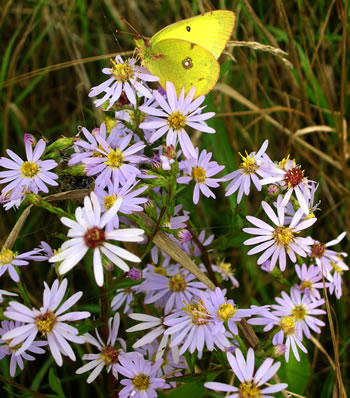
Lindley's Aster (Aster ciliolatus)
-
Native to: BC, SK, MB, ON, QC, NB, NS
-
Habitat: Found in clearings and forest edges. Grows in full sun or partial shade, dry to moist soils.
-
Appearance: One of the early bloomers, its violet flowers are up to 2 cm across. It has few leaves. A sturdy, upright plant that grows from 30cm to one metre tall, it usually has one central flower stalk. Spreads by rhizomes.
Blue Wood Aster / Heart-leaved Aster (A. cordifolius)
-
Native to: MB, ON, QC, NL, NB, PE, NS
-
Habitat: Found in open woods, thickets, and clearings. Grows in sun or light shade. Tolerates dry conditions.
-
Appearance: Flower heads of sky-blue, sometimes pale violet, 2.5 cm wide and heart-shaped leaves. A loosely branching plant that grows anywhere from 60cm to two metres tall.
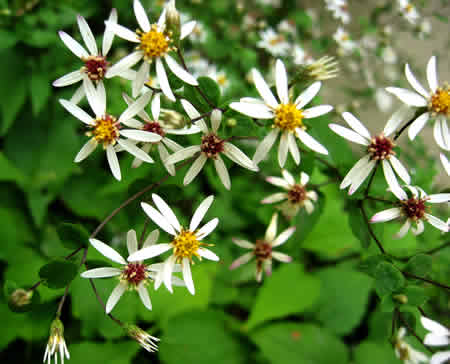
White Wood aster (A. divaricatus)
-
Native to: MB, ON, QC
-
Habitat: Found in dry woods and clearings. Happy with partial shade and dry to moist soil.
-
Appearance: One of the early bloomers, white flowers appear in August, sometimes late July and can last into October. Its white petals contrast beautifully with yellow and burgundy centres and its smooth purple stem. Leaves are almost heart-shaped. A very dainty plant that grows to 30cm to one metre tall. A broadly spreading plant, it looks very attractive planted near large stones.
Heath aster (A. ericoides)
-
Native to: YK, NW, AB, SK, MB, ON, QC
-
Habitat: Naturally grows in dry or moist open places (grasslands, prairies, ditches, roadsides). It prefers full sun and will tolerate a variety of soils.
-
Appearance: A profusion of tiny white flowers borne on plants that can grow to one metre tall. Low spreading growth with many branching stems and tiny leaves. It spreads by rhizomes so give it lots of room or plant near another vigorously growing plant to keep it in check.
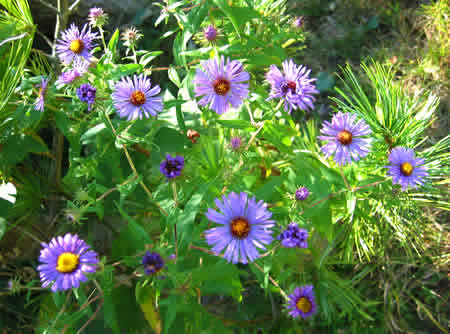
New England aster (A. novae-angliae)
-
Native to: SK, MB, ON, QC
-
Habitat: Grows in fields and along swamp and forest edges. Prefers full sun but will tolerate partial shade, dry to moist soil.
-
Appearance: One of the most stunning asters, it has gorgeous deep purple flowers, 2.5 cm to 5 cm across. Plants typically grow from 30 cm to one metre high but can reach two metres. This is a highly cultivated species available in many colours. It is said to be more mildew susceptible than are other species. Lower leaves wither early so use it at the back of a bed.
New York aster (A. novi-belgii)
-
Native to: QC, NL, NB, NS, PE
-
Habitat: Damp ground, mainly near the coast. Takes full sun and moist soil.
-
Appearance: Another of the more showy asters. Blooms are clusters of bright blue violet flowers. Many varieties exist. There are 30 cm dwarf mounds and 120 cm giants. It is similar to New England aster but has smooth leaves.
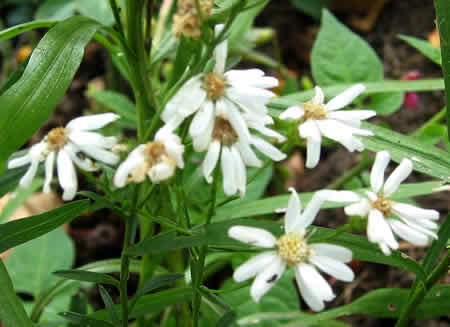
Upland White aster (A. ptarmicoides)
-
Native to: SK, MB, ON, QC, NB
-
Habitat: Found in dry prairies and sandy or rocky soil. Grows in full sun with dry to moist soil.
-
Appearance: A low plant that bears white flowers on branching stems.
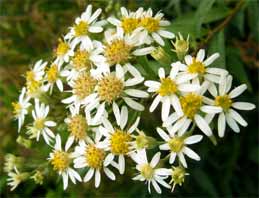
Flat-topped white aster (A. umbellatus)
-
Native to: AB, SK, MB, ON, QC, NL, NS, NB, PE
-
Habitat: Naturally grows in moist thickets and woods or at the edge of swamps. It likes full sun (will take partial shade) and moist soil.
-
Appearance: Many flat or domed clusters of white flowers sit atop thick, greenish-purple stems. One of the early bloomers, starting in August. A tall, bushy plant that doesn't usually need staking. Can grow from 30cm to over two metres.
Native plants add beauty to the garden and provide food for wildlife. Growing them can save both time and money. To learn more about growing native plants in your garden, visit our Get Growing section.
Did we miss your favourite aster or any tried-and-true tips for growing them? Please
e-mail us, or call Sarah Coulber at 1-800-563-9453, or, in the Ottawa area, at 599-9594.


