


Tobi McIntyre
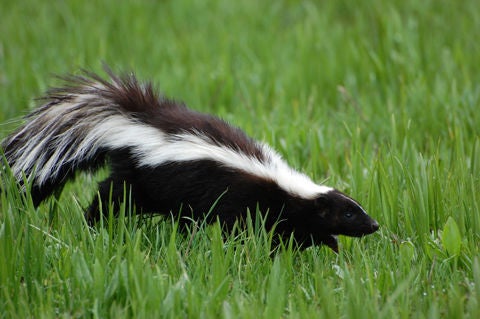
Despite its reputation, the striped skunk (Mephitis mephitis) is one of the most useful small mammals inhabiting Canada’s mixed farmlands, grasslands and forests. About the size of a cat, this critter helps control pests such as mice, grubs and larvae.
Striped Skunk Fact File
Scientific name: Mephitis mephitis
Average weight: 3.25 kg
Average length: 57.5 to 80 cm
Life span: up to three years in the wild and 15 years in captivity
Appearance: stout body, small head, short legs, bushy tail and thick, black, glossy fur. The thin white stripe down the centre of the face forks at the shoulders and continues as a white stripe along each side of the back. Tail is mostly black, but stripes may extend down it, usually to a tuft of white at the tip.
Range: central Mexico to Nunavut and the Northwest Territories; from the Maritimes to west-central British Columbia.
Did You Know?
- Skunks are not aggressive, preferring to retreat from a human or other large enemy.
- That distinctive scent comes from a thick, yellow, oily fluid or musk, secreted by two glands located on either side of the anus at the base of the tail.
- Although its spray deters many predators, bobcats and some birds of prey will attack the striped skunk.
- Skunks begin to awaken from their winter state of torpor by late February in more southerly parts of Canada, and are fully active by the end of March.
- Striped skunks are truly omnivorous, eating a wide variety of foods including mice shrews, ground squirrels, young rabbits, birds’ eggs and various plants.
- Unlike many other animals, the striped skunk it has adapted well to the presence of humans and has expanded its range over time.


