


SCIENTIFIC NAME
Eumeces fasciatus
DESCRIPTION
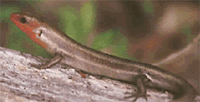
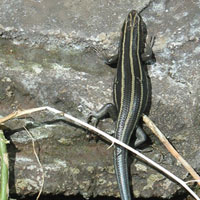
Despite their smooth-skinned appearance, skinks are actually lizards not salamanders. Lizards, which are reptiles, have scales, claws on their feet, and external ear openings, whereas salamanders, which are amphibians, have smooth, moist skin, and lack both claws and ear openings. Five-lined skinks start off life with a bright blue tail and dark body with 5 broad light-coloured stripes. As they age their tail and body fades to a more uniform brown-grey averaging about 15 - 20 cm in length.
PHOTO GALLERY
 | |
HABITAT
These lizards are found in moist woods where there are a lot of logs, stumps, and rockpiles to go along with leaf litter.
BEHAVIOUR
During the spring breeding season, the head and jaws of males turn orange-red to help them attract a mate.
In the spring a nest is created in rotting logs, loose soil, or leaf litter where 4-15 eggs are laid. The female skink guards the nest until the young are born. After only 1-2 days the newborn skinks are left to their own devices.
NOTES
Although active in the daytime, five-lined skinks are very guarded and therefore difficult to spot. If you are lucky enough to catch sight of a skink, observe it quietly from a distance. Do not attempt to handle skinks as their tails are easily broken. Their fragile tails are a defence mechanism to protect them from predators. If confronted or grasped, the skink's tail breaks off and continues to wriggle thus drawing the enemy's eye away to allow escape. The tail will grow back but not to the same length as the original.
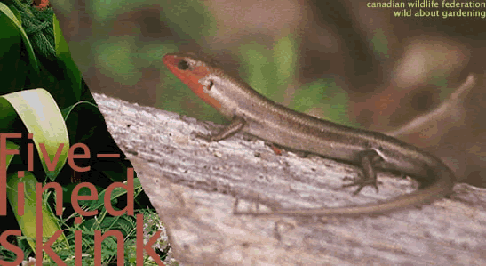
Skinks are cold-blooded, which means their body temperature is regulated by external factors rather than internally. Although wary and secretive, skinks will occasionally lounge on rocks or logs to bask in the sun. In the heat of mid-afternoon they take shelter under rocks, logs, or leaf litter. During winter they hibernate in rotting logs, under large rocks, or underground.
To welcome skinks or other reptiles to your garden, be sure to provide lots of shelter in the form of dense vegetation, brush piles, and fallen logs. A carefully placed rock or log that receives morning sun will serve as a welcome basking spot. In wooded areas allow leaf litter to accumulate naturally. They will reward these efforts by consuming crickets, flies, grubs, and other insects.


