


Name/Org : Allan Baker, Royal Ontario Museum
Status:Completed
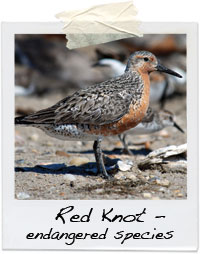
DESCRIPTION The red knot is a shorebird which uses the Mingan Archipelago National Park Reserve in eastern Quebec as a stopover, or refueling, site during their fall migration. It stops in the area after leaving its nesting site in the Arctic while migrating to its wintering site in South America. Because this bird’s population has decreased by 72% in the last 10 years, it is now considered a species at risk in Canada. For three years (2010-2012), crucial data on the red knot’s population has been collected in the area. This has helped estimating its population size and reproductive success. Observations of banded birds also helped figure out survival rates form one year to the next.
Results:Over the three years of the study, the researchers have highlighted the critical importance of the Mingan Archipelago as a stopover site for red knots. The red knots spending time in Mingan weighed as much as 200g, suggesting the birds are refueling well at the site. In 2010, at least 3,800 adult red knots (or about 1,900 breeding pairs) were observed (less were counted in 2011, but this is likely an underestimation).
The first wave of birds arriving in the area in July is larger in numbers and includes both failed breeders and possibly some females that laid early clutches, as females leave after the eggs hatch. Breeding males stay 3-4 weeks longer in the Arctic to brood and protect the young, and one of the main findings of the study was that analyzing the number of males arriving in Mingan was a way to determine if a breeding season had been successful: during good breeding seasons, this second wave of migrants arriving in August is larger than normal, arrives later and is composed mainly of males that raised young. This was observed by the researchers in 2011 (but not in 2010 nor 2012), and since these males were followed by 600 juveniles (a very large flock) arriving about the second week in August, the hypothesis was confirmed.
With the help of population size, the number of juveniles, the ratio of males and females in the area and banded bird observations, the researchers could create a model to assess red knot population viability in the long run. This model suggests that to recover, a greater number of adults and juveniles need to survive from one year to the next. Although the habitat in Mingan seems to help, red knots are still under threat by a possible depleted food supply at the final refueling site in Delaware Bay or poor breeding success in the Arctic. But hopefully, with studies like this, we’ll be able to lend the red knot a hand.


