

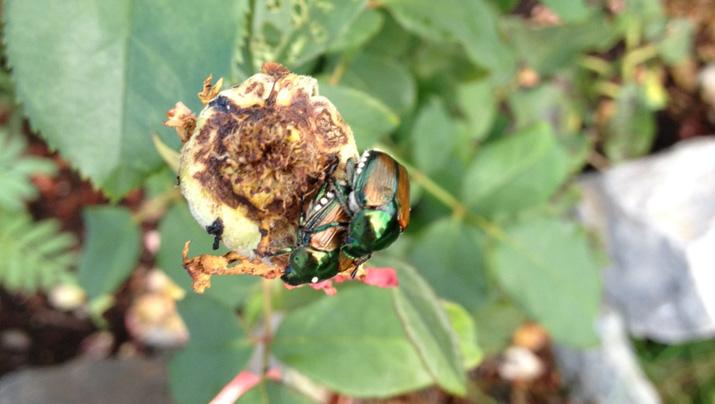
A. You may be referring to Japanese beetles. First found in Canada in 1939, Japanese beetles are native to the main islands of Japan. They feed on more than 250 different plant species, including species in the rose family. Some other plants that are affected by Japanese beetles include maple, elm, birch and fruit trees such as apple, raspberry and cherry.
Japanese beetles have only one generation each year. Adults appear in the summer and have a life span of about 30 to 45 days. Each female deposits as many as 60 eggs in the soil, and approximately two weeks later the eggs hatch. When colder weather arrives the larvae (grubs) go deeper below the surface, where they spend the winter. Adult beetles emerge around late June and early July and can reach their greatest numbers in late July and August.
Typical damage by Japanese beetles is caused by the beetle chewing the tissue between the veins of the leaf, and they can also chew out large areas on some leaves and flowers.
The most effective natural control is to hand-pick the beetles off the plants and place them in a bucket with soapy water. Morning is the best time to do this as the beetles are not as active.
You can also apply nematodes. The best time to apply nematodes is when the grubs are feeding near the surface, typically in the spring and early fall.
I hope this helps!


