


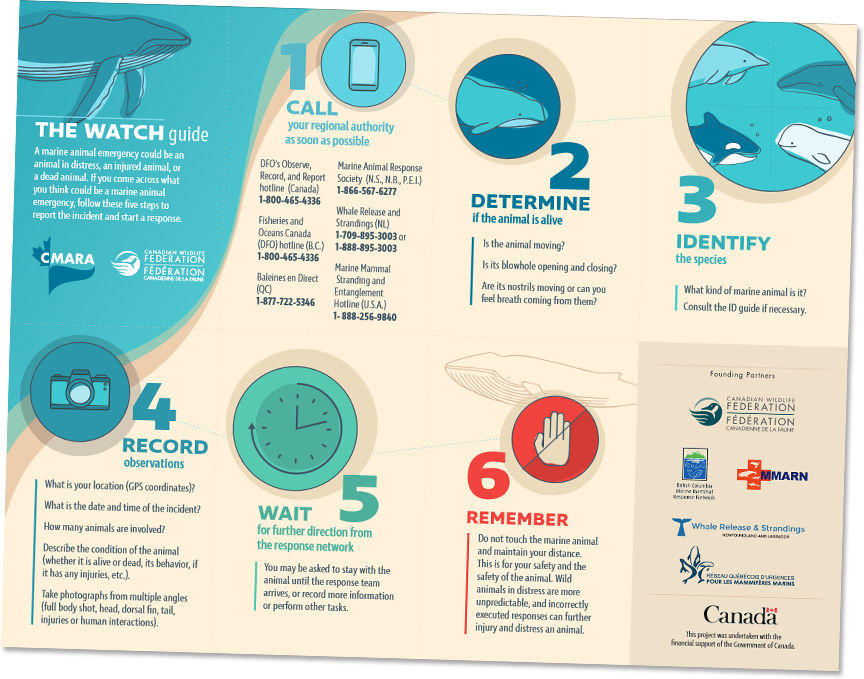
Download the free 5 step guide and identification chart so you are always prepared in case of a marine animal emergencyDownload the PDF
A. There is actually a Canadian Marine Animal Response Alliance (CMARA) that is a network of marine animal response groups, which is chaired and coordinated by CWF.
These groups depend on you to let them know about marine animals that are in distress, injured, even those that are dead. They depend on observations from the public so much that they created The Watch. The Watch lets you know what to do in these situations so that the appropriate actions can be taken.
Remember though to always put your safety first! Keep your distance and don’t touch the animal. Animals that are in distress can be very unpredictable.
What exactly is a marine animal? It includes whales, dolphins, porpoises, sea turtles, seals, sea lions and sharks.
The Watch’s 5 Steps to Reporting a Marine Animal Emergency are:
Step 1: Call your regional authority as soon as you can. Organizations and contact numbers can be found here!
Step 2: Is the animal alive or dead? Is the animal moving? Is its blowhole opening and closing, are its nostrils moving?
Step 3: Identify the species. The Watch has an ID guide that may help. Click here!
Step 4: Record observations:
• What are you GPS coordinates?
• What is the date and time of your observation
• How many animals are involved?
• What condition is the animal in?
• Take photographs from different angles, if you can
Step 5: You’ve done all you can! Wait and see what the response network says. They may ask you to record more observations or to stay with the animal.
Be sure to visit CMARA’s website, specifically the section The Watch. You’ll be able to get their 5 Step Guide and identification chart as a print-out for your wallet or downloaded to your device. You can even test your marine animal knowledge with their quiz!
Knowing what to do in these kinds of situations can not only save a marine animal but can lead to important conservation research.


