


DESCRIPTION
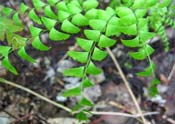
Ferns are known for their lacy look, with leaves (called fronds) divided into leaflets (pinnae). Some species’ leaflets are divided just once, as with the common polypody and Christmas ferns, while others, such as the lady fern, are divided twice (bipinnate).
SIMILAR SPECIES
PHOTO GALLERY
(Please note — these photos are unverified images submitted by members of the CWF Photo Club.)
HABITAT
A fern's preferred habitat are shady spots with moist, rich soil that is well-drained. Some species can handle sunnier conditions but they typically need consistent moisture to thrive. Ferns that tolerate drier conditions grow best in shady spots, which hold moisture longer.
BEHAVIOUR
Ferns have a different development system than the typical seed plant. Spores develop into small plants with male and female parts. Egg and sperm come together to form a zygote, which then becomes a young fern.
PRIMARY ECOSYSTEM ROLES
Animals and birds, such as the snowshoe hare, white-tailed deer, grouse and wild turkey, also find some ferns tasty. And ferns offer great shelter for small animals and birds to safely rest, feed or hide.
NOTES
One of the first life forms to evolve on Earth, ferns are thought to pre-date dinosaurs and flowering plants. They appeared at the end of the Devonian period, approximately 350 to 400 million years ago.

By Sarah Coulber
While the allure of flowering plants is captivating, there is much to be said for the lush look of a fern. Used as accents to flowers or centre stage themselves, ferns have a unique appearance that deserves a second look.
One of the first life forms to evolve on Earth, ferns are thought to pre-date dinosaurs and flowering plants. They appeared at the end of the Devonian period, approximately 350 to 400 million years ago.
Canada is home to a great diversity of native ferns, each containing a multitude of genuses. Some species are distinct, while others are challenging to identify. Some ferns grow as tall as a person, and some don’t even reach to your knee. What they all possess, however, is the ability to enhance a garden and provide a safe spot for wildlife to rest or forage for food.
Appearance
Ferns are known for their lacy look, with leaves (called fronds) divided into leaflets (pinnae). Some species’ leaflets are divided just once, as with the common polypody and Christmas ferns, while others, such as the lady fern, are divided twice (bipinnate).
One way to identify a fern is by the arrangement of its spores, which are similar to seeds. They are so small and dust-like that we usually notice only the spore clusters that contain them. These can be found on the underside of leaflets (fertile leaflets), such as on the fragile and Christmas ferns; or on separate stems (fertile leaves), such as on the sensitive and ostrich ferns. Then there is the royal fern, whose spore clusters form on a stem at the tip of some of its leaves. Another variation is the interrupted fern, whose brown fertile leaflets are found sandwiched between sterile leaflets.
Species of ferns with spore clusters on the back of leaflets can be identified by the shape of the cluster. Some are horseshoe or kidney shaped, while others are round. You can look for their placement on the leaflet: along the edge (margin), as with the marginal wood fern, or near the midvein, as with the spinulose woodfern (also called toothed woodfern).
The appeal of some ferns extends beyond the summer months. The Cinnamon fern, for instance, turns a lovely shade of yellow in the autumn, while the Christmas fern stays green all winter — hence the name, which probably refers to its use as a Christmas decoration.
New leaves growing in the spring are always interesting to note. Tightly curled, they slowly unwrap themselves before looking like a typical fern leaf. In fact, the young leaves are called fiddleheads, due to their similarity to the head of a violin, or fiddle.
Uses
Aboriginal peoples have long used ferns for healing and nourishment. The fiddleheads of some species are edible, and the roots, or rhizomes, of some ferns have been used in treating all sorts of physical ailments, from bruises and jaundice, to asthma and kidney problems.
Animals and birds, such as the snowshoe hare, white-tailed deer, grouse and wild turkey, also find some ferns tasty. And ferns offer great shelter for small animals and birds to safely rest, feed or hide.
Not all ferns are considered safe to ingest, however, and some that are edible may be so only in small quantities. If you plan to experiment, ensure you do your homework before you start sampling.
(Caution: We are not recommending the use of these plants for medicinal or food purposes. Many plants are poisonous or harmful if eaten or used externally. The information here on food and medicinal value is for general interest only; its accuracy has not been verified.)
Propagation
Ferns have a different development system than the typical seed plant. Spores develop into small plants with male and female parts. Egg and sperm come together to form a zygote, which then becomes a young fern.
To try growing ferns at home, tap spores onto a sterile mix, mist and cover with plastic.You can also divide mature ferns in early spring or fall, or let the ferns do it themselves by spreading their underground rhizomes.
Care
Ferns are generally low-maintenance plants so long as they are planted in their preferred habitat — shady spots with moist, rich soil that is well-drained. Some species can handle sunnier conditions but they typically need consistent moisture to thrive. Ferns that tolerate drier conditions grow best in shady spots, which hold moisture longer.
Here at the Canadian Wildlife Federation’s head office, where our demonstration gardens encircle our building, we grow ferns in our shadier beds that have only early morning sun. Once established, the ferns take care of themselves and are a perfect element in our woodland gardens.

Christmas fern — Polystichum acrostichoides
- Native to: ON to PE.
- Habitat: Grows in moist woods and along wooded rocky slopes. Prefers moist ground with light to full shade but can handle drier spots.
- Appearance: 30–50 cm. Leaves start upright and gradually relax and lower themselves to the ground as summer progresses. Leaves are once-divided, with leaflets having a spur or lip near the base pointing upwards. Spore clusters of reddish-brown dots are on undersides of leaves in rows of two or more. Evergreen.

Maidenhair fern — Adiantum pedatum
- Native to: BC, southwest AB, ON, QC, NB, NS.
- Habitat: Grows in moist, rich woods and along rocky mountainsides. Prefers partial to full shade and moist soil but can handle drier conditions.
- Appearance: 30–60 cm. Dark reddish-brown stems, pale green leaves that are twice-divided. Sub-leaflets have little notches on the upper side. Spore clusters form along the edge of the upper margin of sub-leaflets. The overall plant has a circular shape and delicate appearance. Spreads slowly.
- Note: Some refer to the ferns growing in the northwest and Gaspé regions, which have fewer leaflets and more deeply cut sub-leaflets, as A. pedatum var. aleuticum (a variation of maidenhair ferns), and consider them a separate species (A. aleuticum).
Royal fern — Osmunda regalis
- Native to: ON to NL.
- Habitat: Grows in moist woods, shorelines and wet ditches, and prefers shade but can handle sunnier spots.
- Appearance: 90–150 cm. Leaves are twice-divided, with dark brown leaflets with spore cases at tips of some leaves.

Ostrich fern— Matteuccia struthiopteris
-
Image of an ostrich fern.Native to: NT, BC, SK to NL.
The inset shows the
fiddleheads in spring. - Habitat: Grows in moist woods and thickets, and prefers partial to full shade but can handle sunnier spots.
- Appearance: 70–120 cm. Leaves are widest at middle, and once–divided, with leaflets that gradually narrow toward the base of the leaf. Leaflets have lobes that could be considered sub-leaflets. Has separate fertile leaf. Stalks are deeply grooved in front. Spreads quickly.
Lady fern — Athyrium filix-femina
- Native to: YK, BC to NL.
- Habitat: Grows in swamps, damp meadows and thickets, and prefers partial shade and moist soil but can handle drier conditions.
- Appearance: 60–90cm. Leaves divided two or three times, giving it a very lacy appearance. Spore clusters form a kidney or horseshoe shape on back of sub-leaflets. Spreads slowly.
Sensitive fern — Onoclea sensibilis
- Native to: SK to NL.
- Habitat: Grows in moist soil such as swamps and wet roadsides and forest edges, in partial to full shade but can handle sunnier spots.
- Appearance: 40–70 cm. Spores are on separate fertile leaves, which are once-divided with wavy leaflets. Bottom leaflets are not joined but become joined toward the tip. Spreads quickly.
Polypody fern — Polypodium virginianum
- Native to: NT, BC to NL.
- Habitat: Grows in open to deep shade, creeping across rocks and crevices in woods. Prefers moist soil that is very well drained.
- Appearance: 20–25 cm. Leaves are once-divided with spore clusters in two rows on the undersides of leaflets.
Images: Sarah Coulber


